


2026.11.16
News release- Nippon Steel Engineering Co., Ltd.
Selected for Japan Cabinet Office’s “Marine Unmanned Vehicle (Marine Drone) Demonstration Project”
– Developing a Basic Plan for the Practical Deployment of Marine Drones for the Maintenance and Inspection of Offshore Wind Facilities –
Nippon Steel Engineering Co., Ltd. (Representative Director and President: Yukito Ishiwa, “NSE”), in collaboration with Toyo Engineering Corporation (“TOYO”), IHI Corporation, ITOCHU Corporation, Oki Electric Industry Co., Ltd. (“OKI”), and FullDepth Co., Ltd. (“FullDepth”), has been selected for the “Marine Unmanned Vehicle (Marine Drone) Demonstration Project (Basic Plan Development),” publicly solicited by the Cabinet Office National Ocean Policy Secretariat, with its proposal to develop a practical deployment model and basic plan for the maintenance and inspection of offshore wind facilities using marine drones.
Project Overview
Marine unmanned vehicles (marine drones) are expected to play an increasingly important role in reducing manpower requirements, improving operational efficiency, and enhancing capabilities for marine observation.
Building on the outcomes of the FY2025 project*1, the project team will examine a future vision for the maintenance and inspection of offshore wind facilities using marine drones*2 around 2030 and develop an initial practical deployment model. The team will also develop a basic plan for demonstration activities toward practical deployment, together with a roadmap outlining the direction of continued technical development and the establishment of relevant institutional, certification, and operational frameworks toward 2040.
Drawing on the on-site expertise it has gained through the construction of offshore structures, NSE will lead the development of the basic plan for demonstration activities under this project. NSE will also examine how inspection data acquired by marine drones can be combined with various types of facility and operational data, and work to develop concrete data solutions that enable more advanced maintenance and inspection.
Development of an Initial Practical Deployment Model
The project team will develop an “initial practical deployment model” envisioning the use of marine drones for the maintenance and inspection of offshore wind facilities around 2030.
Based on the needs of offshore wind power operators as well as site and facility conditions, the team will examine inspection methods using marine drones and related technologies, system configurations, operational frameworks, data utilization, expected benefits, and business feasibility. Through these studies, the team aims to establish a practical deployment model that can be applied across multiple offshore areas.
Development of a Basic Plan for Demonstration Activities
To realize the practical deployment model, further technical development will be required, together with integrated verification of the various technologies and systems involved.
The project team will therefore develop a basic plan for demonstration activities envisioned for FY2027 through FY2030. The plan will cover candidate demonstration sites, the scope of demonstration activities, implementation structure, schedule, estimated costs, and evaluation methods. The team will also examine a phased approach to technical development, verification activities, and field demonstrations.
Development of a Roadmap toward 2040
The use of marine drones for the maintenance and inspection of offshore wind facilities is expected to remain at a developing stage in 2030.
The project team will therefore examine the direction of continued technical development, enhancement of business models, and the establishment of relevant institutional, certification, and operational frameworks required for further deployment. These considerations will be organized into a roadmap toward 2040.
Overview of the Implementation Structure
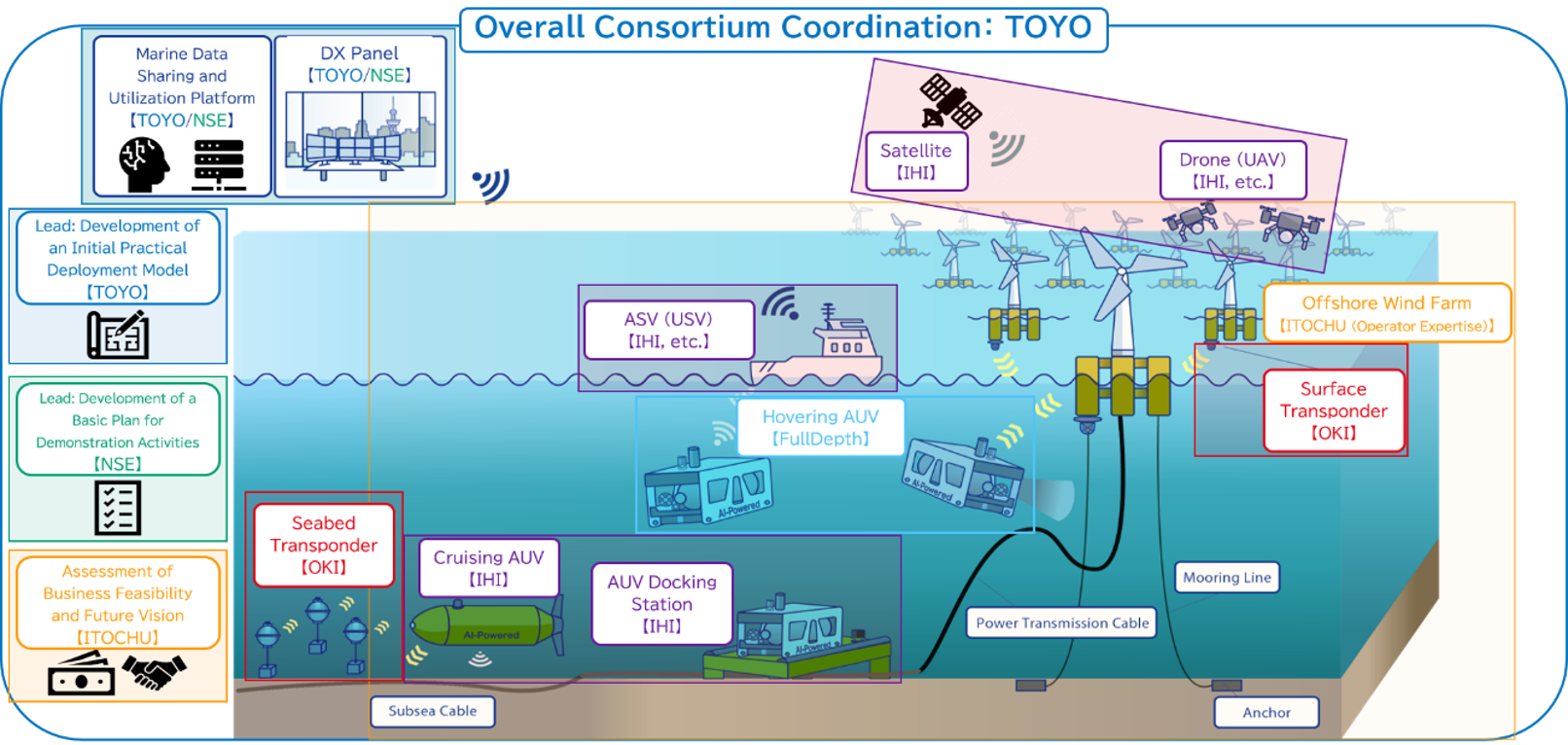 Implementation structure integrating marine drones, marine infrastructure, data utilization, and business feasibility assessment
Through this project, NSE will work together with the project partners to accelerate the practical deployment of marine drones.
In addition to their application to the maintenance and inspection of offshore wind facilities, NSE aims to expand the utilization of marine drones to a broad range of marine fields, including renewable energy and marine resource development, thereby contributing to the realization of a sustainable society and addressing social challenges in the marine sector.
- *1 In the FY2025 “Autonomous Underwater Vehicle (AUV) Demonstration Project,” publicly solicited by the Cabinet Office National Ocean Policy Secretariat, TOYO, NSE, FullDepth, and OKI jointly proposed a roadmap for the practical deployment of a system for unmanned underwater inspection of offshore wind facilities using AUVs and related marine robotics.
- *2 In this release, “marine drones” is used as a collective term for marine unmanned vehicles, including ASVs, ROVs, and AUVs.
ASV (Autonomous Surface Vehicle): An unmanned surface vehicle capable of autonomous navigation.
ROV (Remotely Operated Vehicle): An unmanned underwater vehicle operated remotely.
AUV (Autonomous Underwater Vehicle): An unmanned underwater vehicle that uses onboard equipment to recognize its position and surroundings and navigate autonomously.
Related Information
Press release on the outcomes of the FY2025 project (March 30, 2026)
https://www.eng.nipponsteel.com/news/detail/20260330/
【For more information, please contact below】